Parabolic trough systems are the most mature concentrated solar power technology in commercial deployment. They're widely used for industrial process heat, district energy, and large-scale electricity generation. They are also widely misunderstood — confused with solar photovoltaic, mistakenly considered exotic, or assumed to require Mojave-Desert sunlight to be economic.
This article is a practical overview for operators, technical decision-makers, and procurement leads considering a parabolic trough installation.
How the technology works
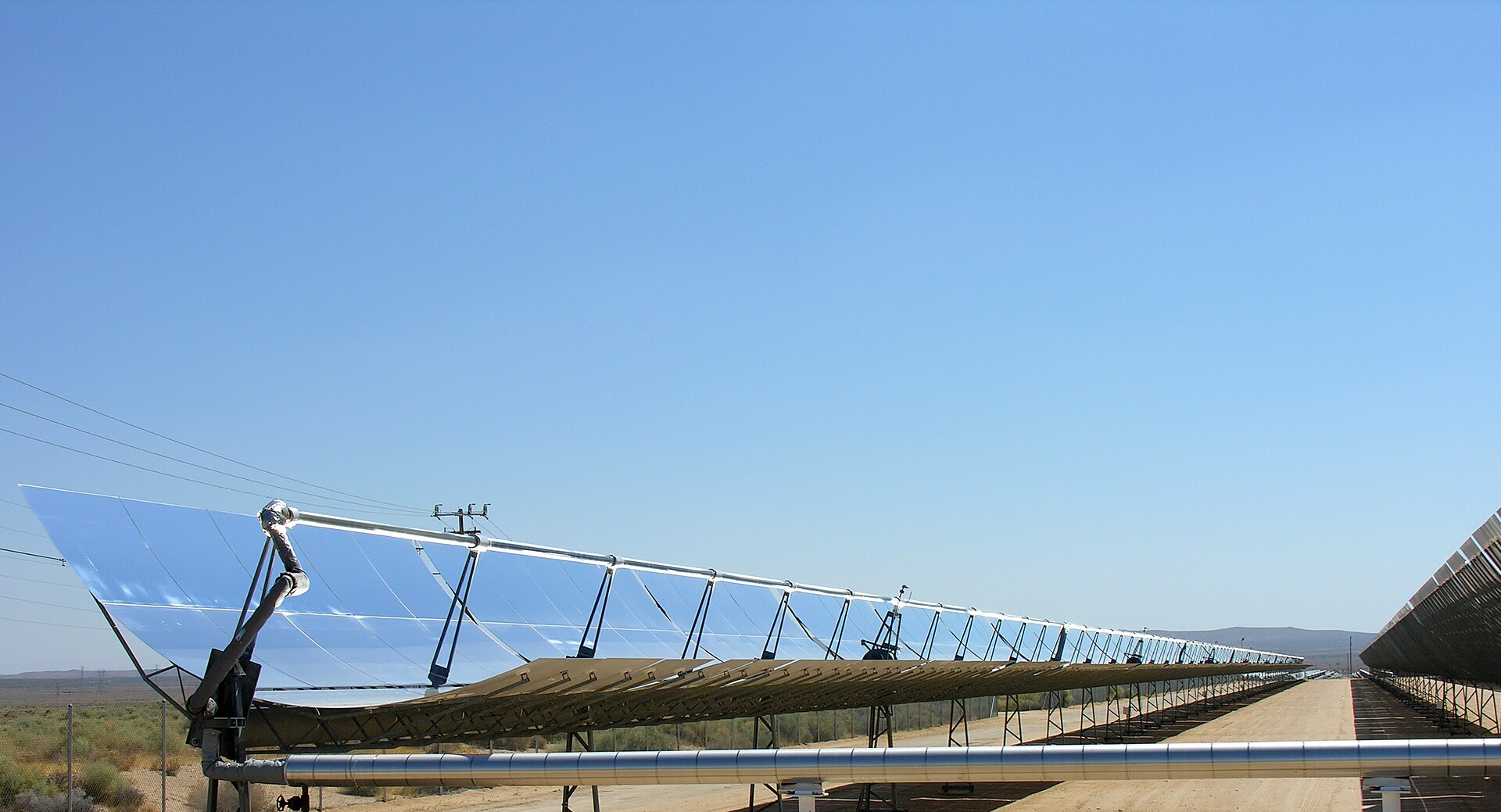
A parabolic trough is a curved mirror, several metres long, that concentrates direct sunlight onto an absorber tube running along the focal line. The absorber tube contains a heat-transfer fluid — typically a synthetic oil, molten salt, or water/steam depending on the design.
The concentrated sunlight heats the fluid to high temperatures (typically 200°C to 400°C in commercial systems, higher in research designs). The hot fluid is then circulated through a heat exchanger to produce useful process heat, hot water, steam, or — at very large scale — to drive a steam turbine for electricity.
The trough tracks the sun on one axis (usually north-south), keeping the focal line on the absorber throughout the day. The result is a high temperature, controllable heat output, well suited to industrial applications that previously relied on fossil-fuel-fired boilers.
What makes it different from solar PV
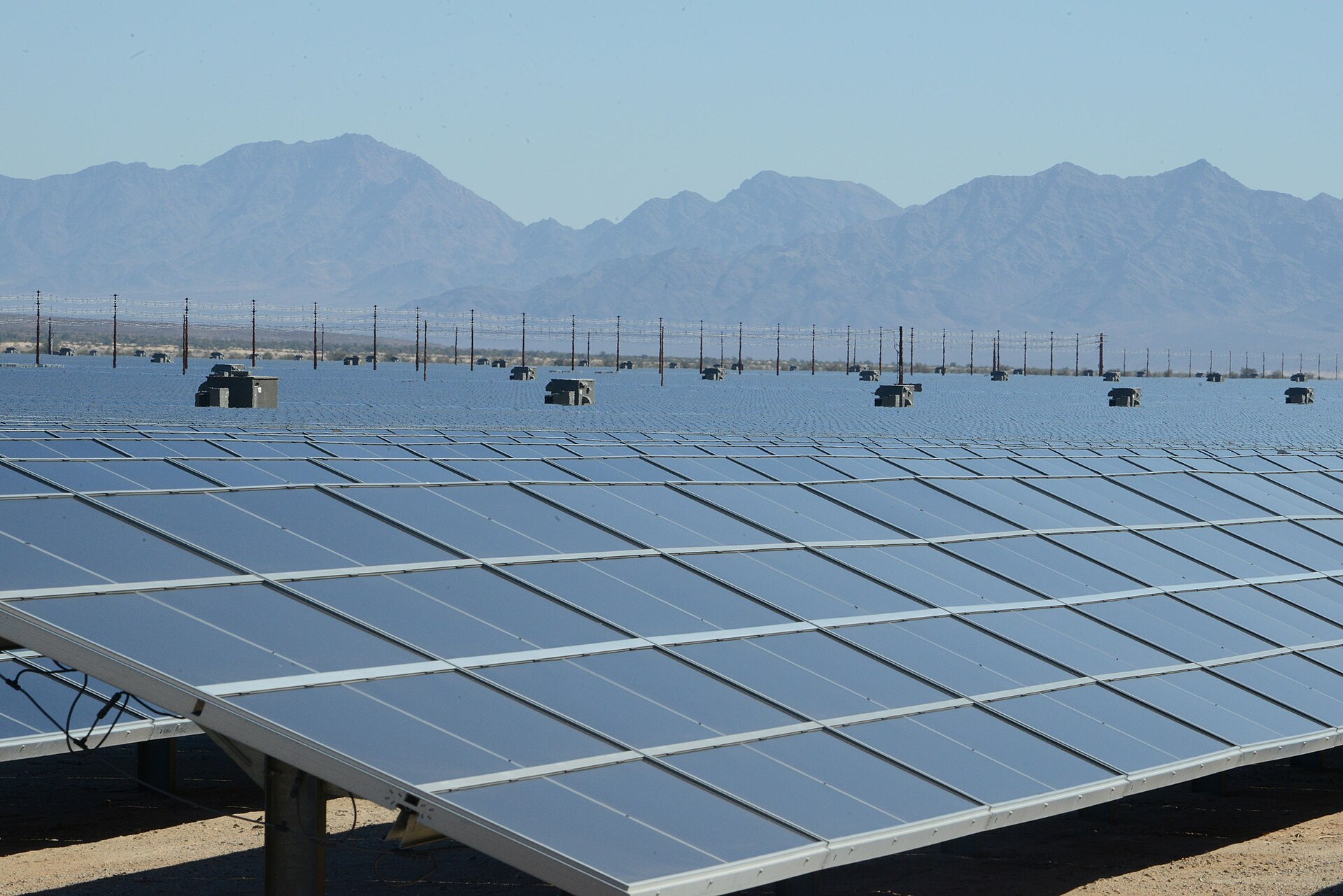
Solar photovoltaic converts sunlight to electricity. Parabolic trough is a solar thermal technology that delivers heat directly. The comparison is application-dependent:
- For electricity: solar PV is dramatically simpler and cheaper at commercial scale.
- For process heat: parabolic trough is two to three times more energy-efficient per unit collector area.
- For high-temperature heat: parabolic trough is one of the only commercially mature solar options.
The two technologies are not competitors — they solve different problems.
Where parabolic trough fits
Parabolic trough systems are economic for:
- Industrial process heat between 100°C and 400°C. Food processing, dairy, textile dyeing, pharmaceutical sterilisation, chemical processing.
- District heating networks with significant daily hot water demand.
- Desalination plants using multi-effect distillation.
- Combined heat and power installations where heat and electricity are both required.
- Enhanced oil recovery in upstream oil and gas operations.
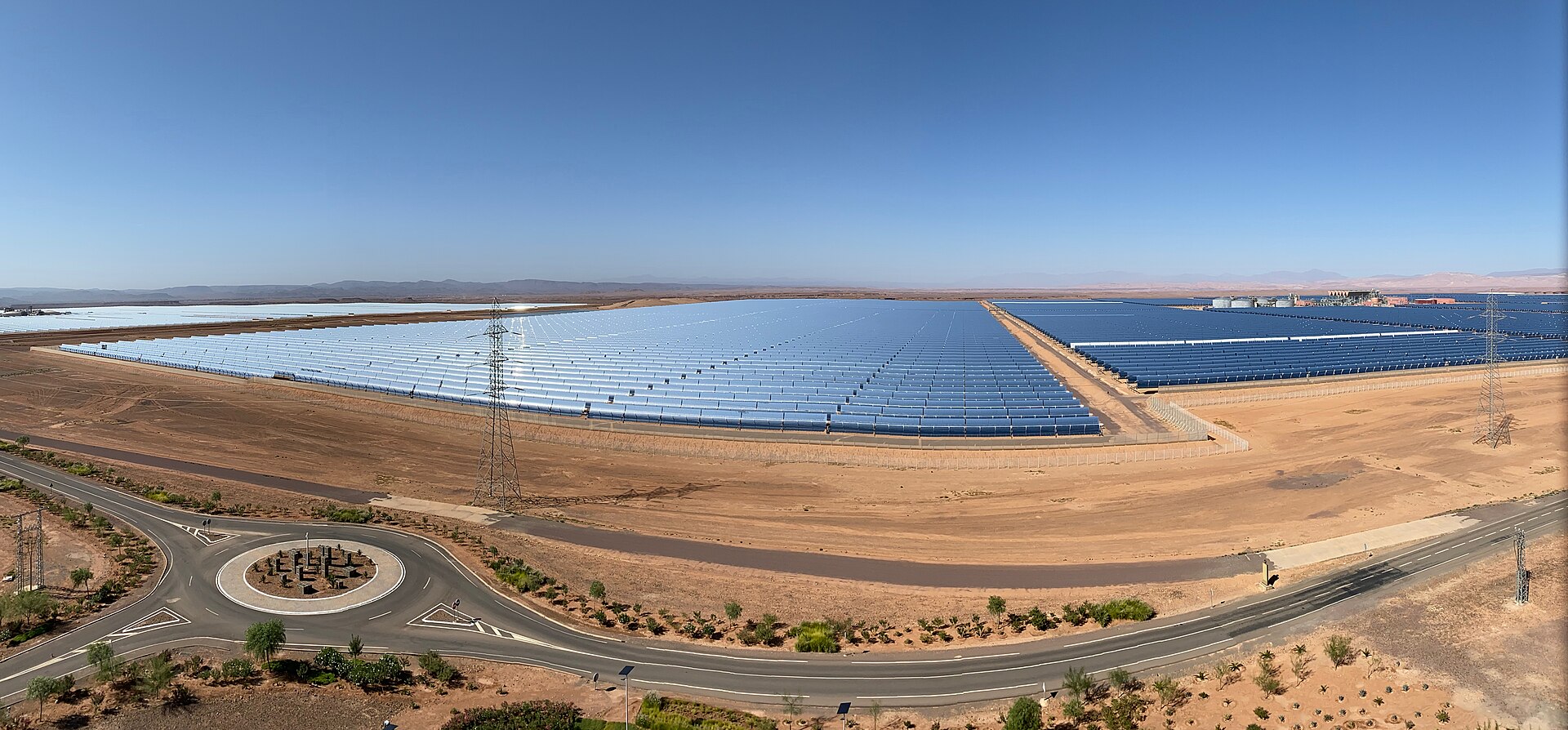
They are most economic at scale — typically 500 kW thermal and above — and in locations with strong direct sunlight (above ~1,800 kWh/m²/year of direct normal irradiance). The MENA region, southern Europe, parts of Australia, the American Southwest, and northern Chile are prime geographies.
What an operator needs to know
For decision-makers considering a parabolic trough installation, the practical questions are:
Site requirements. A flat or gently sloped area with minimal shading, oriented to maximise direct sunlight exposure. A 1 MW thermal system typically requires roughly 4,000 to 6,000 square metres of collector field, plus space for the power block and ancillary equipment.
Heat-transfer fluid choice. Synthetic thermal oils are common for temperatures up to ~400°C. Molten salts allow higher temperatures and thermal storage but introduce freezing-point challenges. Direct steam generation simplifies the cycle but limits temperature flexibility.
Storage. One of the strengths of parabolic systems is integration with thermal storage. Several hours of stored heat lets the system deliver consistent output through cloud cover and into the evening — something solar PV cannot do without batteries.
Operating temperature target. Higher target temperatures generally mean higher capital cost per kW thermal but better integration with existing industrial processes. The sweet spot is matching the system temperature to what the downstream process actually needs.
Operation & maintenance discipline. The most important factor in long-term performance. Mirror cleaning frequency, tracking calibration, absorber tube integrity, and heat-transfer fluid management all matter. A well-operated parabolic system can deliver 25 years of useful life. A poorly operated one degrades fast.
Common misconceptions
"It only works in the desert." Parabolic systems perform well in any climate with high direct normal irradiance. The MENA region, southern Spain, parts of Italy and Greece, and parts of the UK with strong summer sun are all viable.
"It's only for utility-scale power." A significant share of installed parabolic capacity globally serves industrial process heat applications below 5 MW thermal. The "utility-scale CSP plant" image is the most visible deployment, not the most common.
"It needs water." Open-cycle systems use water for cooling. Closed-cycle systems, including most industrial process heat applications, use far less water than typical industrial boilers.
"Maintenance is exotic." Maintenance is mostly mirror cleaning, tracking system calibration, and standard piping/insulation work. It is not more complex than a modern boiler installation; it is different.
How PNM UK works
PNM UK designs, supplies, and maintains parabolic trough systems for industrial and commercial clients across the United Kingdom and the MENA region. Our work includes engineering consultancy, system design, supply, commissioning, operation & maintenance, and spare parts supply.
We do not push parabolic technology where it doesn't fit. We start from the heat demand profile and recommend what works — which is sometimes parabolic, sometimes flat-plate solar thermal, sometimes a hybrid with PV, and sometimes a recommendation to invest in efficiency before adding solar at all.
If you operate an industrial site with significant process heat demand and want a technology-neutral assessment, start a conversation.
Final thought
Parabolic trough systems are a mature, well-understood, commercially proven technology. They are not exotic, and they are not future technology. They are an operating decision available today, for industrial sites that have honestly looked at their heat demand and want to reduce its fuel cost for the next twenty-five years.
- parabolic trough
- concentrated solar power
- industrial process heat
- solar engineering
- PNM UK